Why does the Sabio Assessment exist?
Its goal is to train traders to survive real markets — where protecting capital matters more than posting screenshots on social media with rocket emojis.
The market tends to punish bad risk management. Indeed, many traders blow accounts because they overtrade, refuse to close losses, go full cowboy after one winning day, or treat risk management like a “suggestion.”
At Sabio, every rule is designed to help traders build professional habits:
- protect the account,
- control emotions,
- avoid terminal losses,
- and survive by staying in the game long enough to compound.
This article explains the meaning and purpose behind each rule — even if some may feel obnoxious.
What Is the Sabio Assessment — and Why Do These Rules Exist?
The assessment is a evaluation challenge where traders must:
- reach a target balance,
- stay within risk limits,
- follow consistency rules,
- and close positions properly.
Once passed, traders unlock a funded account with access to real capital and potential payouts. In other words, we double-check your professional execution — and whether you’re ready to manage the large funds we provide.
But assessment rules are not only about us — it’s about you.
Understanding the Core Rules
1. Profit Target — Builds Your Perspective
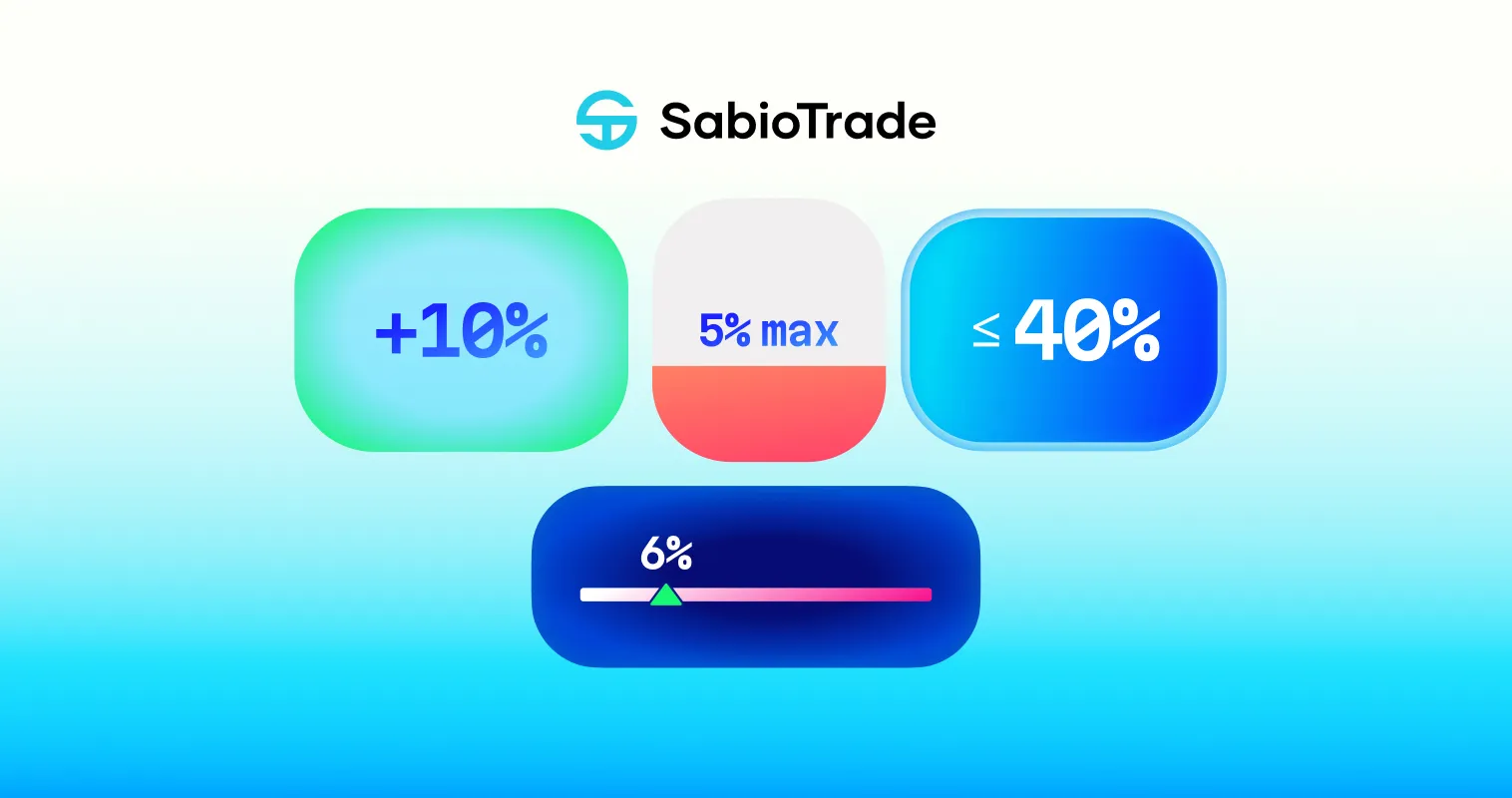
During the assessment, your goal is to grow the account by 10%.
Example:
- Initial Balance: $650,000
- Profit Target: 10%
- Required Profit: $65,000
|
Why so? Because having a profit target is a proven risk management principle in trading.
Instead of seeing a 10% target as a barrier, think of it as a defined finish line. In the real world, traders often struggle because they don’t know when “enough is enough.”
- Psychological Safety: A profit target provides a clear exit point for the evaluation phase, preventing the “over-trading” trap where a trader gives back gains because they lack a specific goal.
- Capital Trust: Reaching the target proves to the firm — and the trader — that the strategy can perform under specific constraints. It’s the final “green light” before managing larger capital.
2. Daily Loss Limit — The Emergency Brake
Traders frequently view the Daily Loss Limit as a “stop-out” meant to end their day. However, it’s, in fact, a professional circuit breaker.
Example:
- Daily Loss Limit: 5%
- Max Daily Loss: $5,000
If losses exceed that amount in one day, the account is breached. |
Here’s why this rule is good for you:
- Emotional De-escalation: The most dangerous thing a trader can do is try to “win back” a loss while in a heightened emotional state. The Daily Loss Limit automates the discipline that most of us lack in the heat of the moment.
- Longevity Training: It teaches the “1% Rule” — the idea that no single day should ever be catastrophic enough to end your career.
- Statistical Alignment: Most strategies have a daily “max loss” beyond which the probability of a recovery becomes mathematically slim. This rule keeps the trader aligned with the math of their own edge.
💡 Tip: Don’t trade up to your limit. If the limit is $5,000, you should act as if your personal limit is $4,000. This $1,000 “buffer” ensures that even a bit of slippage or a fast-moving market doesn’t end your evaluation prematurely.
3. Max Trailing Drawdown — The Professional Safety Net
While the daily loss limit saves your day, this rule protects your account from catastrophic losses.
Example:
- Max Trailing Drawdown: 6%
- Allowed Drawdown: $6,000
If your balance drops below the allowed level, the account is breached. |
Traders often fear drawdowns, but in fact, these are risk management guardrails. They teach “capital preservation.” A trader who respects a 6% max drawdown is learning the exact skill needed to survive a 20-year career.
💡 Tip: If a trader has a $100,000 account with a 6% limit ($6,000), hitting a $2,500 loss should be viewed as a “yellow light.” It forces a pause, preventing the emotional “revenge trading” that leads to account blowing.
4. The Consistency Rule — Building a Career, Not a Gamble
The Consistency rule is often the most misunderstood rule by traders. Sabio uses the 40% Daily Threshold — if one day’s closed profit exceeds the threshold, your target balance may increase.
Example:
- Your plan’s target profit: $10,000
- Daily threshold (40%): $4,000
- You make: $5,000 in one day
That exceeds the threshold by $1,000.
The formula to calculate how much will the target profit increase if the trader exceeds the recommended daily profit is:
New Target Profit = Biggest Daily Profit / 0.4
New Target Profit = 5000/0.4 = 12,500
→ The target balance increases by $2,500 |
The goal of this system is to teach traders to avoid relying on one oversized trade, “all-in” behavior, or the “lottery ticket” trading. If a trader hits their target in one lucky trade during a news spike, they haven’t proven they are a good trader — they’ve proven they are lucky.
5. The Closed Trades Only Rule — Secure Gains Habit
At Sabio, only closed trades count toward assessment results.
Why? Because floating profit is not real profit.
Closed trades force traders to secure gains, manage exits, and trade with intention. It teaches one of the most important lessons in trading: unrealized profit is just the market teasing you.
Certain behaviors are restricted at Sabio:
- HFT (High-Frequency Trading)
- Scalping
- Hedging / Cross-account hedging
- Arbitrage
- Unapproved algorithmic trading
We ban them because the goal is to evaluate actual trading skills and real decision-making. The assessment is designed to mirror real-world capital management — where firms prioritize consistency and controlled execution.
In other words, the goal is not to “game the system,” but to become the kind of trader who can survive real market conditions over the long term.
6 Good Habits You Get From the Sabio Assessment
Underneath all the rules, Sabio is training traders to:
- Survive volatility
- Preserve capital
- Avoid emotional decisions
- Think like professionals
- Control risk
- Master stable execution
Anybody can get lucky for one day. Professional traders survive for years. That’s the mindset we aim to build from Day 1.
Final Thoughts
The Sabio Assessment rules are not designed to trap traders — they’re designed to prepare them for what’s coming. The market will always test you, and Sabio helps you train before those tests become expensive.