So, order blocks mark areas of high institutional interest. That final candlestick before a massive price expansion. That’s the point of origin marking institutional intervention. These zones are added into historical volume data, forming footprints that serve as highly reactive support and resistance levels later on.
| Feature |
Order Blocks |
Traditional Supply & Demand |
| Foundation |
Algorithmic liquidity sweeps and intent |
Historical buying or selling pressure |
| Precision |
Isolates the exact final opposing candle |
Broader consolidation ranges |
| Validation |
Requires structural breaks and Fair Value Gaps |
Relies on simple multi-wave patterns |
Bullish Order Block, Bearish Order Block, and Other Types of Order Blocks
Institutional players leave different types of footprints for different market phases. But to truly take advantage of this, you must learn how to accurately identify them. Candlestick patterns, luckily, can be used for this job. Bullish engulfing, for example, tends to confirm the shift in momentum immediately after the block forms.
The 3 main types of order blocks are:
Bullish Order Block
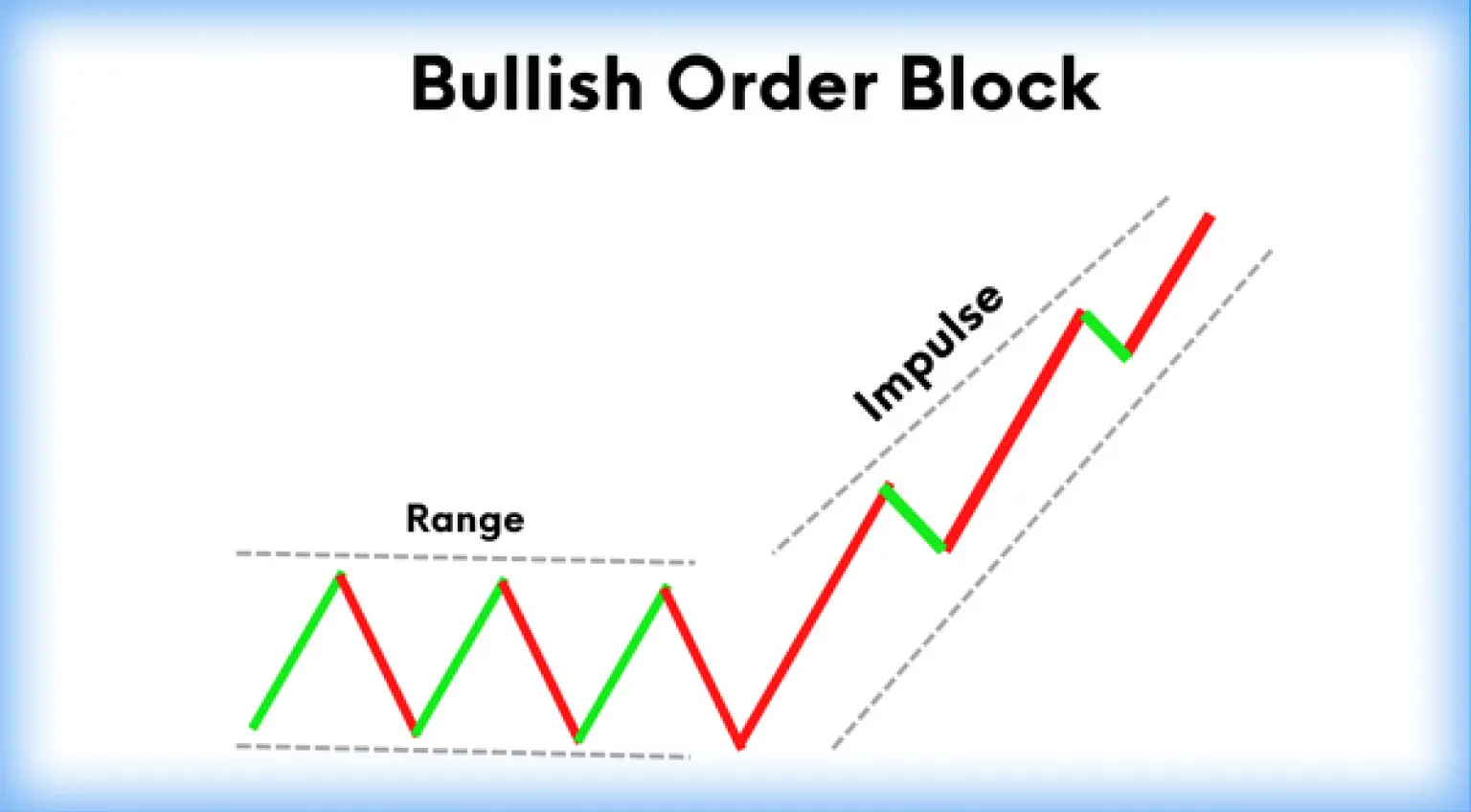
This block emerges during institutional accumulation. Visually, they form as the last bearish candle preceding a violent upward move. The market sweeps sell-side liquidity, fills buy orders, and reaches new highs with violent speed.
Bearish Order Block
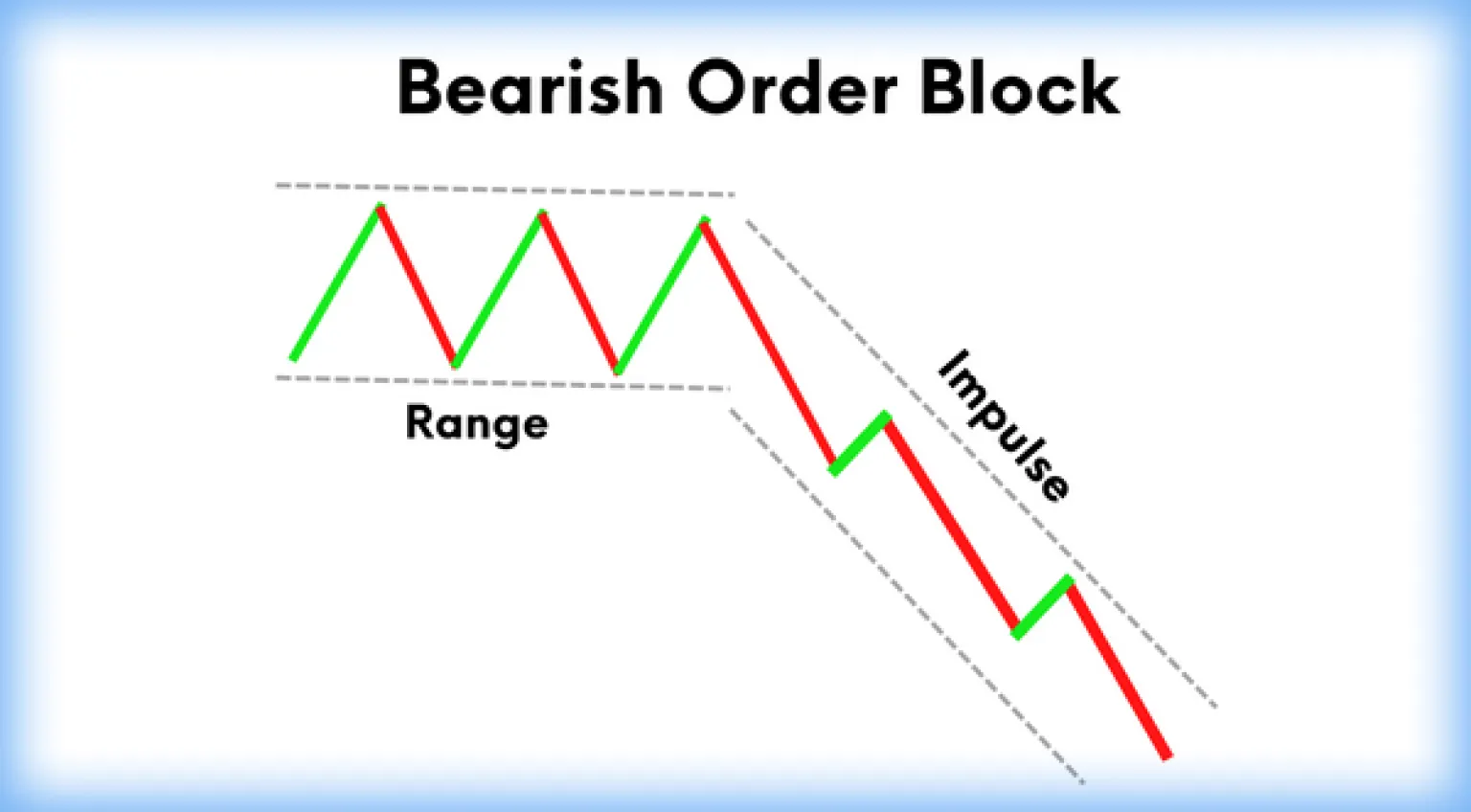
This pattern, contrary to the above, marks institutional distribution. The last bullish candle prior to a massive drop creates the bearish order block. Institutional players push the price upward to trap breakout buyers, then bring it back down to new lows.
Breaker Block
In essence, breaker blocks represent a block failure. When prices smash right through an order block, the strength flips to the other side. A failed bullish order block transforms into a bearish breaker block.
Valid Order Blocks in Forex and How to Distinguish a Strong Order Block From a Weak One
Even if you know the concepts of border blocks and learned how to identify them, making sure that what you’re seeing is in fact a valid order block can be tough. Reliable trading opportunities require severe qualification filters.
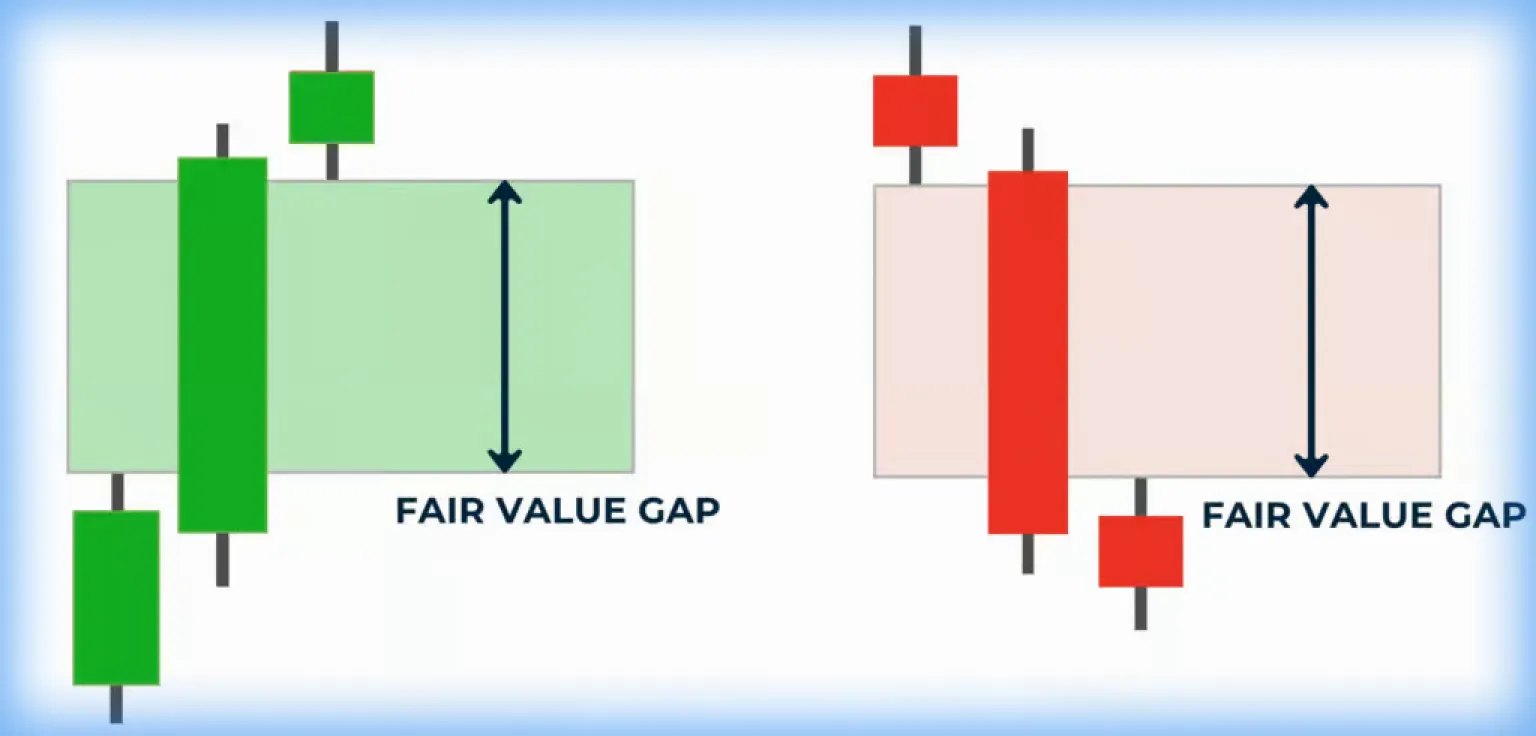
Strong order blocks work best only when accompanied by explosive displacement. If the price moves too slowly, what it shows is a lack of intent. Valid order blocks move with violence. Usually, it leaves a fair value gap that proves that the institutional players were able to absorb all liquidity, leaving a void behind in the price chart.
Order Block Trading Strategy Examples
It’s often a bit more complex to identify order blocks. They don’t work the same way basic chart patterns do. Luckily, you can find competent order block indicators on TradingView. These are built by the community and there are tons of them you can test.
Below, we have order blocks examples with an OB indicator built by the community
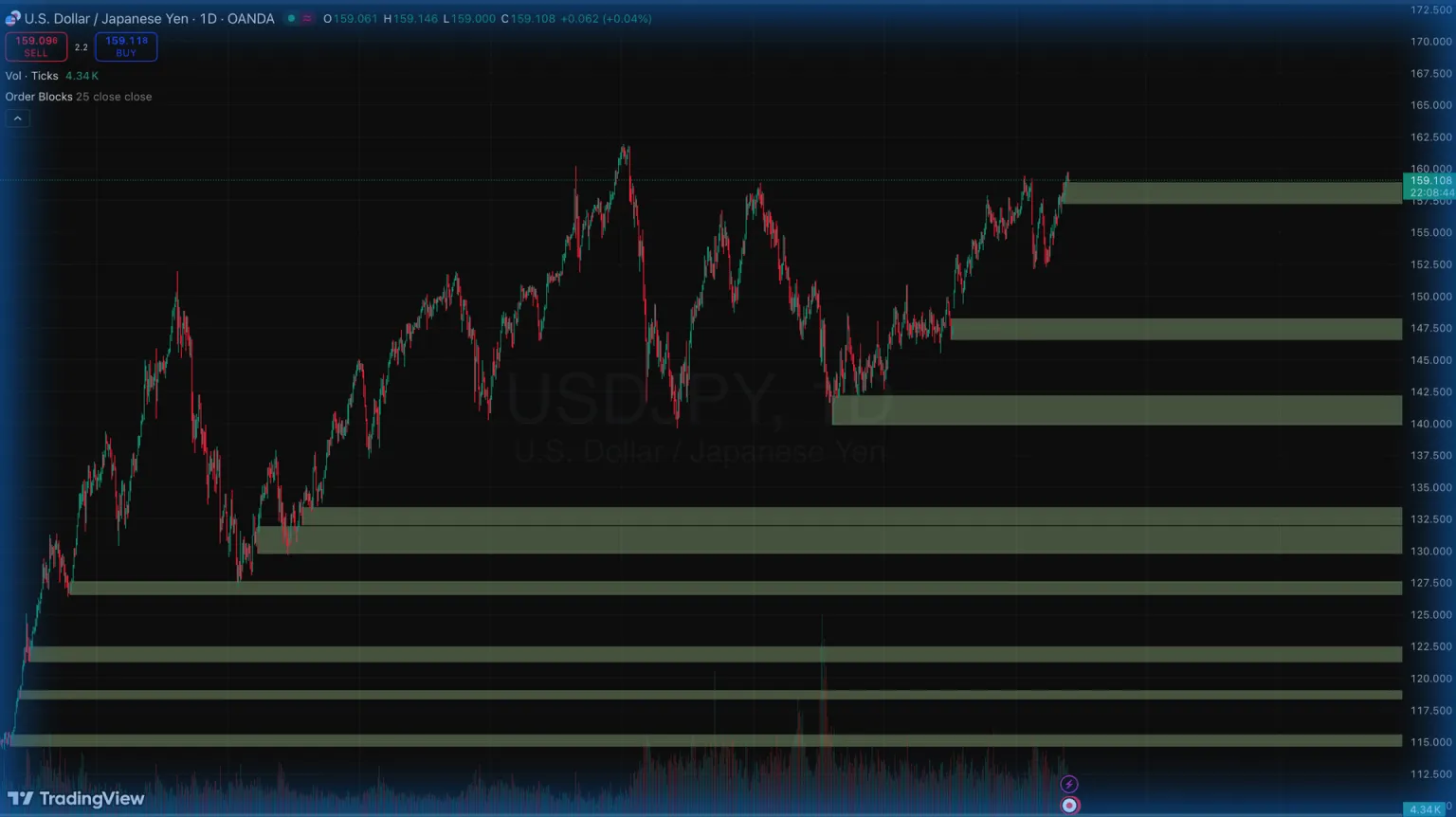
We have the U.S. dollar against the Japanese yen on a daily timeframe. The indicator highlights zones where large institutional accumulation happened over the days and projects them forward as shaded green bands. The market has a tendency for swinging around these bands before experiencing a violent upward move. These green levels represent bullish order blocks.
Traders use these areas as strong levels for support. When price pulls back to these levels, resting institutional buy limit orders could trigger, which would in turn push the market higher.
In the example above, a buying order could be placed right after prices started swinging back up from touching the green band at around 127.500 in early 2023. Prices reached a relevant zone, and demonstrated strength with the formation of a bullish pivot.
Rules for Trading with Order Blocks
You can trade ICT Order Block strategies however you’d like. However, there are certain parameters that form the backbone of every mature system for trading order blocks. Our goal is to maximize reward at the same time we minimize risk and protect capital.
- Use higher timeframes to define the broader range. Strictly control your entries so that you buy in discount zones and sell in premium zones.
- Patience is extremely important. Order blocks may remain untested for days. Let the price retest important zones before deciding to enter the market. Capital preservation comes before profits.
- After defining the broader range with a higher timeframe, switch to a lower one to pinpoint the entry trigger. This is called a top-down analysis and it’s very effective in reducing risk exposure.
- Execute your orders and always place a stop-loss to avoid overly large penalties if the analysis fails.
When you use order block strategies, especially in Forex trading, it’s always recommended to have a strict confirmation framework. A complete trading plan is based on the observation of price action in the lower timeframe based on the touch of relevant zones within the higher timeframe.
It doesn’t matter if you’re employing swing trading techniques or agressive scalping day trading. These rules are valid across every trading time window.
Limitations of Order Blocks and Common Errors when Working with Them
Order blocks trading concepts are indeed powerful, but people very often misapply them. You have to recognize the limitations of order blocks in Forex trading and others.
The number one mistake is pattern recognition without structural context. Executing trades on random blocks without aligning with the macro trend is the same as placing a gamble. That’s why you must use both high and low timeframes to get a fuller picture.
Another common mistake is analysis paralysis. Beginners, although not only them, tend to try to map every single 1-minute block. If you try to track every tiny detail, it’ll become hard to actually do anything.
Ignoring the fact that volatility is based on different timezones is yet another mistake. Order block forms from algorithmic moves. These moves are usually reliant on the New York City and/or London trading volume. Order blocks formed during the Asian session might not have the same institutional backing and could fail more often.
Last, but not least, is not understanding that order blocks trading strategies require contextual alignment. You have to filter out noise by combining the analysis with timeframes typically used in institutional trading.
Final Arguments
Trading with institutional order flow and order blocks are profitable incorporations to your skillset. It changes your market perspective, from reactive indicators to more advanced concepts.
The drivers of price action are located in zones where smart money engineers liquidity. And that’s precisely where you want yo employ capital, so you can capture a part of the trends market whales ride.
Identifying an order block is not as straightforward as identifying candlestick figures. This is an advanced methodology that takes time to master. In your journey, you have to practice endurance. The market will penalize impatience and emotional-based execution.
Keep yourself dedicated to the art of chart studying, backtesting, and risk management. The latter will ensure you can survive the learning curve. This is a journey that requires dedication, but the analytical edge you gain from it justifies the effort.