Types of Futures Contracts
One of the biggest factors to take into account is the type of contract you will trade. Decades ago, trading futures required significant capital. A single contract for Crude Oil controlled 1,000 barrels, and a move of just $1 meant a $1,000 gain or lose. This market was inaccessible for most retail traders.
In order to lower the entry barrier, the industry started splitting the contracts. In practice, this move resulted in new futures products designed specifically for those who want to trade futures but don’t have a large amount of capital.
Standard contracts are the original full-sized contracts. They have the largest value of all types of contracts and might require some thousands of dollars to trade safely. E-mini contracts, such as the e-mini S&P 500, are a fraction of the size of standard contracts. Micro contracts are even smaller fractions. These e-minis and micro contracts make it possible to start trading futures while on a smaller account.
| Asset |
Micro Contract |
Tick Value |
E-mini Contract |
Tick Value |
Capital/Risk Multiplier |
| S&P 500 |
Micro E-mini (MES) |
$1.25 |
E-mini S&P 500 (ES) |
$12.5 |
10x |
| Nasdaq 100 |
Micro E-mini (MNQ) |
$0.5 |
E-mini Nasdaq 100 (NQ) |
$5.00 |
10x |
| Gold |
Micro Gold (MGC) |
$1.00 |
E-mini Gold (QO) |
$5.00 |
5x |
By looking at the table, you can see that the capital needed to trade the micro version of the Nasdaq 100, for example, is 10 times smaller than the e-mini version.
Initial Margin and Maintenance Margin in Your Trading Account
Another important concept is margin. In stock trading, margin is a loan from your broker. In futures, margin is not exactly a loan. It represents the minimum amount of money you must have in your account to open and hold a position.
The margin is defined by the exchange and can be adjusted by your broker. Margin requirements vary a lot based on the asset and its expected volatility. There are two types of margin you should be aware of:
- Initial Margin: This is the amount of money required to open a position. To hold one e-mini S&P 500 (ES) contract overnight, the initial margin might be $12,000.
- Maintenance Margin: This is the minimum level of money your account must maintain to keep that position open. The maintenance margin is slightly lower than the initial margin (e.g., $11,000).
If the market moves against you and your account balance drops below the maintenance margin level, your broker will issue a margin call. This is a demand for you to deposit more money as soon as possible.
The margin call requires you to deposit enough funds to bring your account all the way back up to the initial margin level. If you fail to do so, your broker will liquidate your position and lock-in your losses.
Commissions, Fees, and Other Costs
Besides margins and minimum deposit requirements, an undercapitalized trader have to deal with additional costs:
- Commissions: These represent the fees you pay the broker to execute your trades. It is charged per side (i.e., once to get in, once to get out). For micro contracts, this can be as low as $0.25 per side.
- Platform Fees: Many professional trading platforms require a monthly, annual, or one-time fee. Some are “free” but incur in a higher commission.
- Data Fees: In order to see market prices in real-time, you might have to pay additional fees to the service provider you’re using. For non-professionals, this is usually a small monthly cost, but it is not zero.
- Exchange & NFA Fees: These are small regulatory and exchange fees.
These costs bring additional challenges. It is extremely hard to stay profitable on a budget while having to deal with commissions, fees, taxes, slippage, and many other costs. Break even becomes hard under these circumstances.
Realistic Starting Capital Needed to Trade Futures
When it comes to determining a realistic starting capital, we are moving beyond the discussion of broker minimum or margin. We are discussing risk management, above anything else.
The golden rule of risk management is to never risk more than 2% of your total account capital on a single trade. Risk is not your margin, but the amount of money you will lose if your stop-loss is hit. We can use this golden rule to reverse-engineer your ideal starting capital.
- Define Your Strategy: First and foremost, you need a strategy. Let’s stay your strategy is to trade the micro e-mini S&P 500 contract (MES) and requires a 10-point stop-loss to absorb normal volatility.
- Calculate Your Dollar Risk: The MES contract has a point value of $5.00 (a 1-point move = $5.00 gain or loss). Therefore, your risk per trade is 10 points * $5.00/point = $50.
- Apply the 2% Rule: This $50 risk should be no more than 2% of your total futures trading account.
- Calculate Your Capital: If $50 = 2%, then your total capital should be $2,500
So that’s your realistic answer. To trade one MES contract with a 10-point stop-loss, you must have $2,000 for a 2% risk level. If you are more conservative and use a 1% risk rule, you would need $5,000.
This is the financial value that allows you to properly manage trades and survive a sequence of bad trades, which can happen to anyone.
Your strategy determines your capital requirements.
Futures Trading Examples with Different Capital Limitations
How does capital affect your trades? Let’s take a look at two traders executing the exact same trade, but with different capital:
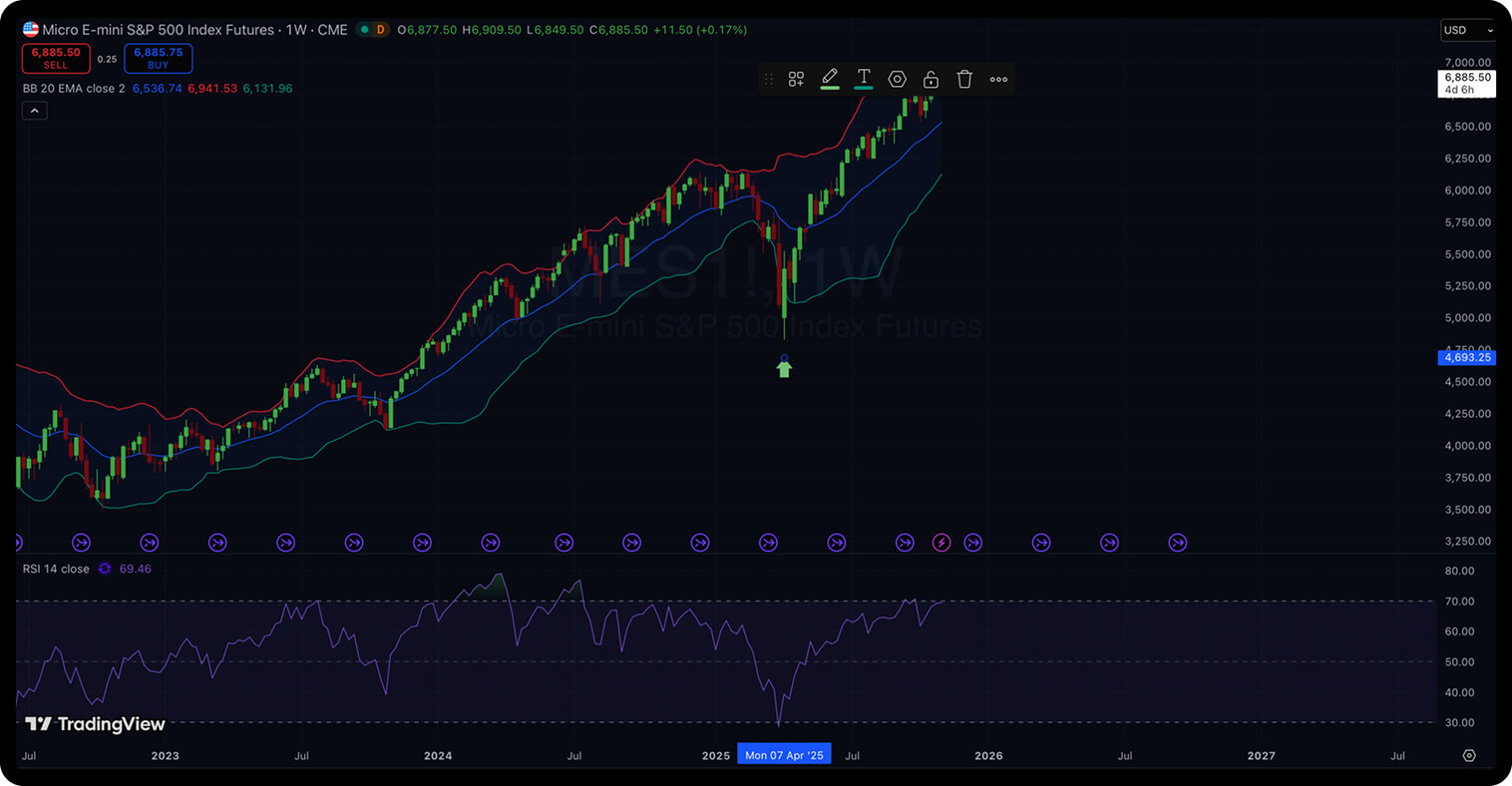
Following technical analysis, the strategy is to buy micro e-mini S&P 500 after prices bounce back from the lower Bollinger Band and RSI bounces back after touching levels below 30.
The stop-loss is 10 points. The Dollar risk is $50.
Trader A
Trader A has a starting capital of $500. If the risk is $50, then that is a 10% risk. Two bad trades and this trader is down 20%, excluding additional costs and fees. This creates a huge psychological pressure. This trader is “forced” to gamble. It is hard to stick to a strategy. It is unlikely to survive in the long-term.
Trader B
Trader B has a starting capital of $2,500. If the risk is $50, it represents 2% of trader’s B account. This is a much more manageable expense. Much closer to how a professional trader operates. Trader B can easily survive if this micro e-mini trade goes wrong. Not only that, but he can easily absorb a sequence of bad trades, which is not at all uncommon. Trader B has more financial and emotional stability to wait for the right circumstances and profit. Costs and fees also have a smaller weight.